

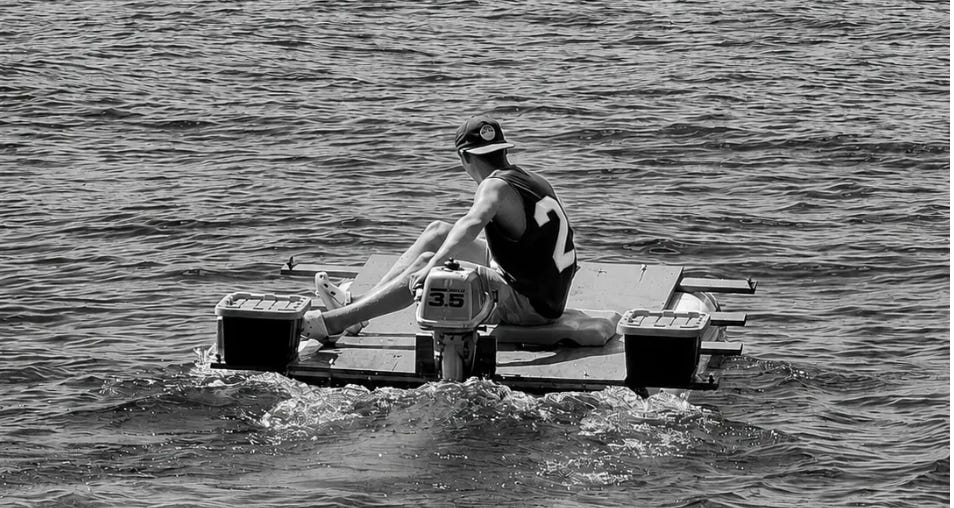
The hull sat in the woods for nearly two decades at my parents camp. Half full of pine needles, pedals seized, one of those things you stop seeing after a while because it has always been there.
My son never stopped seeing it. He is fourteen. Sometime in July he started asking what was under the deck of the thing, and whether the pontoons still held air, and I gave him the answers you give when you are working and the question is not really about the boat.
Then he asked if he could put a motor on it.
I said no twice. Not in those words. I said things like where would you even find a motor that small, and what happens when a wake catches it broadside, and who is paying for the plywood. Those are the adult versions of no. They sound like questions. They are not questions. Every one of them was an approval gate I was inventing in real time to slow down an idea I had not thought about for more than nine seconds, and if you had asked me at the time I would have told you I was teaching him to think it through.
He found the motor. A 3.5 horsepower outboard that had not run since before he was born, sitting in a neighbor’s shed under a tarp, free to anyone willing to haul it away. He cleaned it, and the neighbor's mechanic got it running for him. He decked the hull with a single sheet of plywood, bolted a board across the stern for the motor to clamp to, and dragged the whole arrangement down to the water on Sunday morning without asking me anything else.
It floated. He drove around the lake with his hat on backward, going maybe four miles an hour, grinning like a man who had gotten away with something. Which he had.
What I keep thinking about is what happened next.
He did not admire it. The boat became old to him roughly the moment it worked. Before he had even landed, he was talking about a wider deck, and a longer shaft on the motor because the prop was pulling air every time he turned, and a spot up front to strap a cooler down. The lake had handed him five problems in about four minutes, and he had already converted each one into a feature of the next version. There is no path back to July for him. He cannot see that hull the way he saw it in June. He only moves forward.
That is what an innovator looks like at fourteen. Someone who measures the distance between where a thing is and where it could go, and finds the distance interesting rather than discouraging.
I have spent twenty-five years inside large organizations watching that instinct get taxed out of people, and the uncomfortable part of that Sunday was recognizing my own voice in it. I was the review board. I was well-intentioned, reasonably experienced, and completely wrong, and the only reason the boat exists is that a fourteen-year-old is not obligated to route his ideas through me.
What the distance costs
Inside a company, he would not have that option, and neither do you.
The person who sees what should be built and the person permitted to decide what gets built are almost never the same person. Between them sits distance, and the distance is not empty. It is layers, review cycles, an idea translated into a document, that document translated into a funding request, a quarter spent waiting for a forum that meets monthly, and a dozen versions of the questions I asked my son, asked by people with better titles and worse information than the person who had the idea.
That distance carries a cost the organization pays continuously, whether or not anything ever ships. I call it the alignment tax.
You will not find it on a financial statement. You find it in the write-off on an initiative that was wrong in its first week and took eleven months to prove it. You find it in the year-long program that should have taken a quarter, in the competitor who got to market first with a worse product, and in the capable person who stopped bringing things forward after the third good idea died somewhere in transit and nobody could say exactly where.
Most executives have paid all of that. Almost none of them have ever seen it added up as one number, because nothing in the way we report on ourselves invites the question.
Governance is doing its job
I want to be careful here, because this is the point where an argument like this usually turns into a complaint about oversight, and that is not the argument.
The distance is not all waste. A great deal of it is governance, and governance is important. Capital controls exist because capital gets misallocated. Model risk review exists because models fail in ways their builders do not anticipate. The change process that protects the system of record exists because someone, at some point, took it down. Take those away, and a large enterprise does not become fast. It becomes exposed, and every leader who has run a real function knows precisely what that exposure looks like on the day it finally shows up.
The alignment tax is not the governance. The tax is every decision that gets routed through governance because there was no faster way to find out whether an idea was any good.
For most of the last century, there was no faster way. Learning whether an approach worked meant committing engineers, integrating with the platform, and living with the answer for years. When being wrong cost that much, review had to carry the entire weight of the decision, and the layers that carried it were not bureaucratic excess. They were a rational answer to a real constraint, priced correctly for the world that produced them. My grandfather would have recognized the logic. So would yours.
The economics that justified that structure have changed. Almost nothing about the structure has.
Two speeds
The way out is not less governance. It is noticing that deciding and deploying were never the same activity and no longer need to move at the same speed.
You can now find out whether an idea is worth pursuing in an afternoon, at a cost low enough that being wrong barely registers, and still deploy through every control your business genuinely requires. A regulated insurer and a fourteen-year-old on a dock are not sitting on opposite ends of a trade-off between speed and safety. They are sitting at opposite ends of a question about whether learning happens before or after the commitment.
The organizations that have pulled those two speeds apart are compounding their advantage every quarter against those that have not. That gap does not close by working harder inside an operating model built for a constraint that no longer exists.
The book
I have spent the 10 months writing about this.
THE ALIGNMENT TAX The Economics Changed. Your Operating Model Did Not. Coming Q1 2027
It explains why that distance made sense for a hundred years and what, specifically, changed beneath it. It gives you a way to price the tax within your own organization rather than nodding along to it as a concept. And it describes what an operating model looks like when the constraint that shaped the current one is gone.
Between now and Q1 2027, this is where the work happens. The essays continue. Subscribers here will see chapters that are working and chapters that are not, the cover before it goes public, and the diagnostic instrument before it appears in print. I will write about the publishing process as it happens, including the parts that will be less flattering than the finished book makes them sound.
The lake told my son the truth in four seconds. Most enterprises wait a year for a worse answer, and by then the person who had the idea has stopped asking.
He does not yet know that he will spend his career fighting for something he had for free on a dock this summer. I would like that fight to be shorter for him than it was for me.
Matt Keane is a Chief Data and AI Officer, Professor of Data Science and Analytics, and AI researcher with 20+ years of Fortune 500 transformation experience. His upcoming book, The Alignment Tax (draft working title), explores how organizations can eliminate the alignment tax and build competitive advantage in the AI era.